Kaituna Track
Alerts
Check the DOC website for current alerts and conditions before you go. This site gets current alert info from DOC, but is not an official source of information.
Beautiful native forest and gold-mining relics are the main attractions of the Kaituna Valley. To walk the whole track takes 8-9 hours, or there are shorter walks from 20 minutes to 2 hours.
Elevation
Cover mapped summer 2023/24.
Description
The track starts from the car park at the end of Carters Road and continues right through to Westhaven Inlet on the West Coast (8-9 hours).
Most people, however, walk only to the site of the old Kaituna gold workings (20 min) or on to Kaituna Forks, a 2-hour return trip.
From the car park, cross Little Granity Creek using the footbridge and follow the farm track for 400 m to the start of the walk. A short track takes you past the remains of gold sluicing operations, water races, tailing piles and a small cave. The side track then cuts back onto the main track.
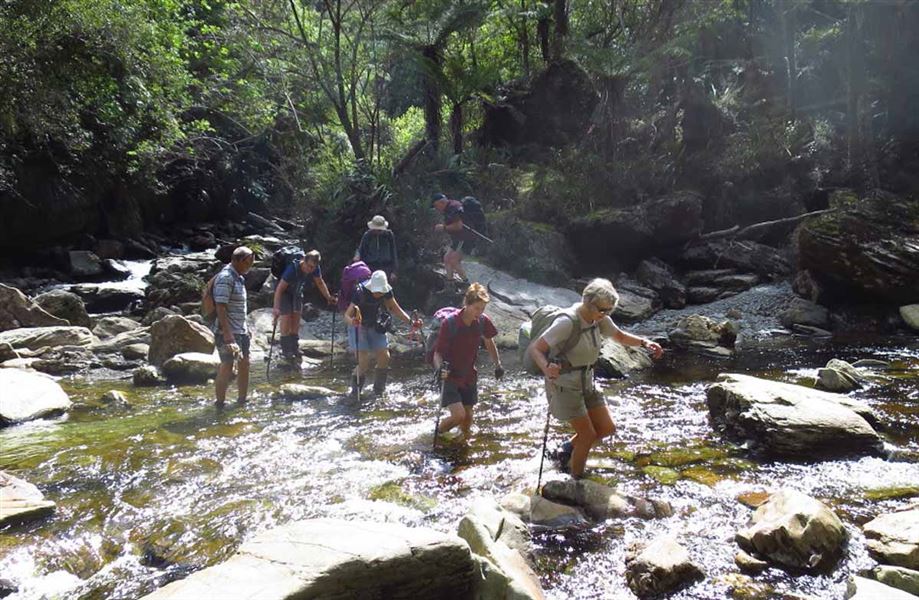
Beyond the Kaituna Forks, the track changes to a 'route' and is suitable only for experienced and fit trampers. At the forks there is a river crossing which is impassable in flood.
From here it is a further 5-6 hours over a marked route to Knuckle Hill. The route climbs over two ridges and crosses two streams before crossing an open pahiki area to the base of Knuckle Hill. There it meets the old logging road that leads down to the car park on Dry Road.
Getting there
Kaituna Track begins approximately 15 km from Collingwood. Follow the main road from Collingwood to Bainham inland to where Carters Road begins, on a tight corner. The carpark is at the end of the road.
Know before you go
There are no huts or campsites on this track.
Nature and conservation
In the beautiful native forest there are magnificent specimens of northern rātā, pukatea and rimu which tower over a sub-canopy of nīkau palms, heketara, wineberry, kāmahi, and māhoe. Beech species are also present.
There are many species of fern, orchid, fungi and perching plants.The rich forest and mild climate allow a wide range of birds to flourish: kererū (the New Zealand pigeon), tūī, fantail, tomtit, bush robin, rifleman, silvereye and bellbird.
History and culture
The Kaituna Goldfield was first worked in 1859 and continued until the late 1800s, although little gold was ever recovered. The present track follows the original pack-horse track to the Kaituna goldfield.
Weather
Forecast at the start of the track